Curriculum workbook pipeline
A Claude Code pipeline that turns the Turkish national curriculum into print-ready English exercise books for an international school in İzmir.
- Category
- Education, content pipeline
- Status
- In production
- Period
- May to Sep 2026
- Role
- Design, build, operate
- Stack
- Node.jsAnthropic SDKClaude Sonnet & OpusPuppeteerExpressmathjssharpPyMuPDFAnthropic Batch APIGit
Context
An international school in İzmir teaches the Turkish national curriculum (MEB) in English, and could not buy the exercise books it needed, because nobody prints MEB-aligned workbooks in English. Each book has to cover the official learning outcomes for its subject and year, read naturally for children learning in a second language, and be correct the first time. There is no second edition for a printed book.
What I built
A pipeline that starts from the official MEB programme PDFs and ends with a bound, print-ready A4 volume. Claude parses and translates the outcomes, including the process notes that quietly define what must not be taught at that year, so a unit that teaches an out-of-scope concept is blocked even when the maths is right. Sonnet drafts each unit as structured JSON; code then enforces the rules the model forgets, such as overwriting outcome codes from the cache because MEB does not number them the way a model expects.
The book itself is rendered by headless Chrome against a frozen design specification: fixed page geometry at 144 pixels per inch, 7 mm writing lines, fifteen implemented question types, and a hard rule that an unimplemented type is a change request, never a silent blank box. Every report is bound by SHA-256 to the exact bytes it describes. Re-render the PDF or edit the JSON and the sign-off is invalidated automatically.
- Data store
- Model or agent
- Check or gate
- Person
- External service
The print gate keys on the category of a defect rather than its severity, because severity drifted between runs while a real answer-key contradiction sat behind a green light for seven weeks. Scope violations, factual errors and answer contradictions block at any severity.
Outcome
Thirty-two units generated across Mathematics, Science and Social Studies for Years 2 to 8, twenty-six rendered to PDF at 25 to 61 pages each, two bound Year 5 volumes, and four books issued to teachers. A unit costs roughly a dollar in model calls, most of it verification. The school has since asked for a costed twelve-course programme.
What I’d do differently
Put the repository under version control on day one instead of ten weeks in, which is how three Year 6 units were lost. Scope units from the books the school actually issues, not the programme document, because a teacher’s book opened with geometry and mine did not. And build the render-fidelity check before shipping anything, not after. The first four books reached classrooms correct, sparse and unillustrated because the brief only asked whether the arithmetic was right.
Screens
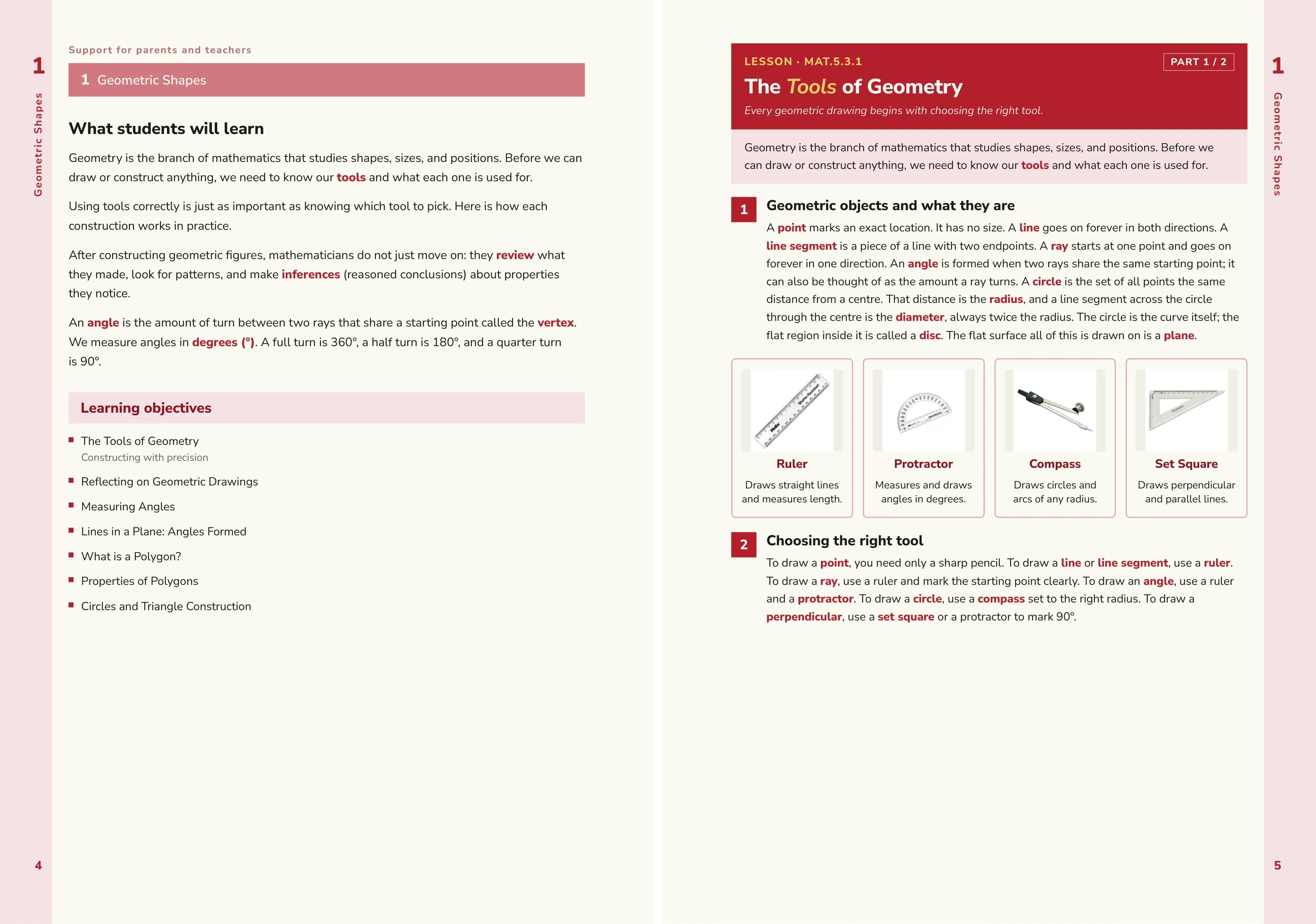
Unit opener. Every unit lists the official outcome codes it covers. Lesson page with photographs embedded by the renderer. Science spread. Worked-example tables are a frozen template block. Drawn figures are declared in the content JSON and checked against what the PDF embeds. Study-guide page, Year 5 Science. Exercise page with a rendered bar chart and 7 mm writing lines. Social Studies, Year 5. The same template, a third subject palette.